
Bridgewater, NJ · Garage Door Service
Off-Track Door Repair for Bedminster's Older Housing Stock
Bedminster homes date to a 1957 median build year, older than most of the service area. We travel 5 miles from Bridgewater to fix track and roller failures on original hardware.
- Repairs & new doors
- Springs & openers
- Serving 6 nearby communities
Where This Job Goes Sideways
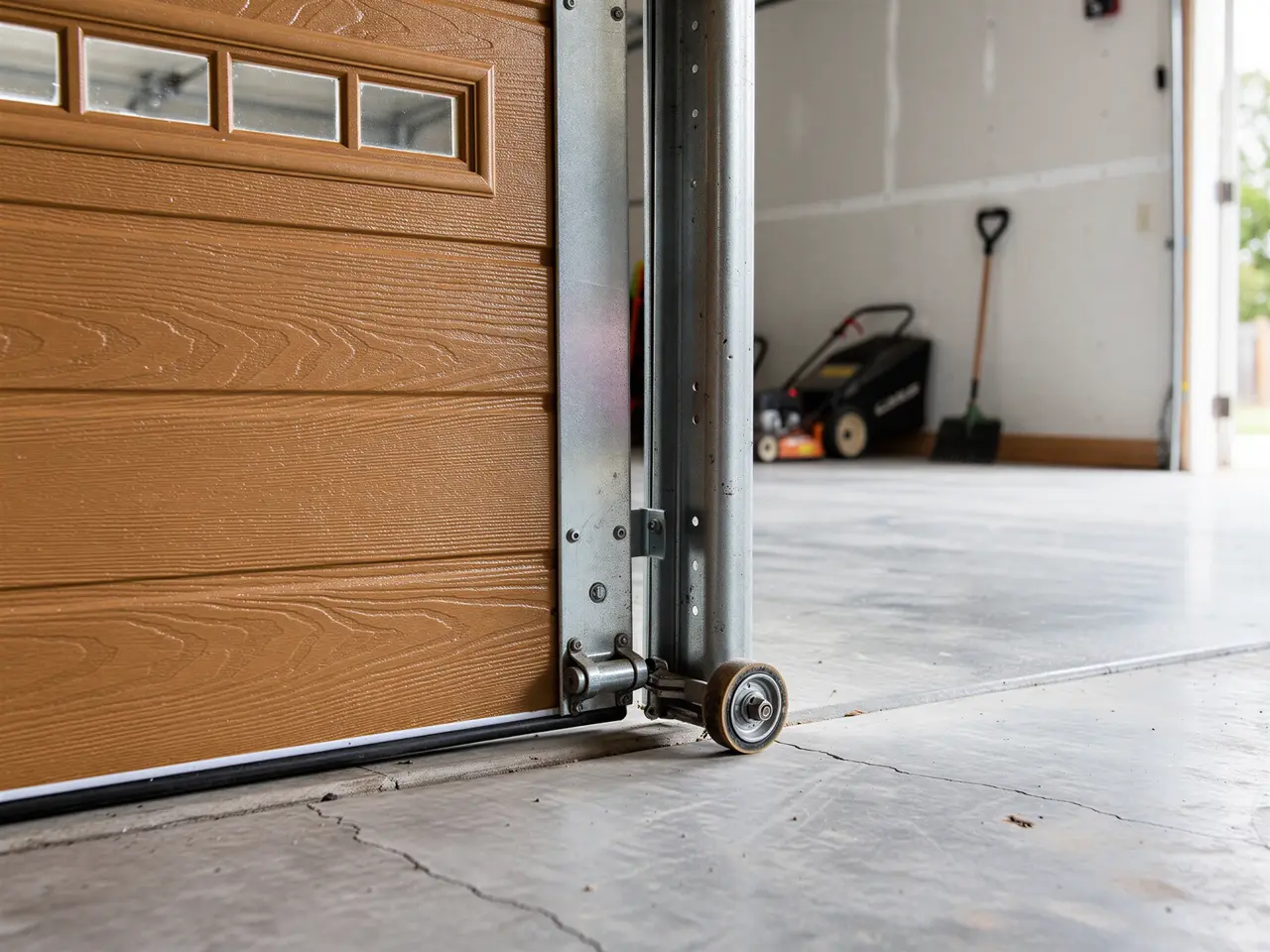
Bedminster's median house went up around 1957, which puts a good chunk of the roughly 532 households here ahead of the broader service area's 1966 median. That matters for one reason: track brackets. A door hung in the late 1950s was almost always set on narrower stock framing than what builders used by the late 1960s and 70s, and the original track brackets rarely got swapped out even when the door itself did. When a homeowner upgrades to a heavier insulated panel decades later and bolts it onto that same original track, the door rides fine for years right up until one bracket finally lets go under the new weight, usually on a cold morning when the steel has contracted and everything's tighter than it should be. The door walks off the track at the bottom roller first, not the top, which throws people because they go looking for damage up high. We come from Bridgewater, about 5 miles out, and the call we get most from this area is a door that's been dragging or leaning for weeks before it finally jumps the track entirely. That lag is the tell. A door doesn't go off-track in one clean motion unless something snapped; it usually walks there slowly while a worn bracket flexes a little more each cycle.
How We Fix It
First thing we check on an off-track call here is whether the track itself is bent or whether the bracket holding it to the jamb has pulled loose from the framing. On houses from this build era the two problems look identical from the driveway but need completely different fixes. A bent track gets replaced in sections, not hammered straight - straightened track holds for a few months and then kinks again at the same spot. A pulled bracket usually means the original wood screws are chewing on dried-out framing that's had sixty-plus years to shrink, so we re-anchor into solid wood rather than just driving a longer screw into the same worn hole. We also pull the rollers while we're in there. If the door's original hardware is still on it, the rollers are almost always steel on a bare stud, not sealed and not nylon, and they're usually the reason the door bound up and twisted the track to begin with. One honest limit here: if the vertical track is rusted through or the jamb wood behind the bracket has gone soft, we're not going to patch that and send you on your way - that's a structural repair past what a garage door call covers, and we'll tell you straight if that's what we're looking at.
Why It Happens Here
The service area runs cold with real winter severity, not just occasional frost, and that's a factor on top of the age issue. Steel track contracts in hard cold, and on a door that's already riding on an undersized original bracket, that contraction is often the last bit of movement it takes for a roller to pop loose at the bottom corner. Combine that with a median build year sitting roughly a decade ahead of the area's broader 1966 median, and you get more original, unreplaced track hardware per household here than in the newer pockets of the service area. None of that shows up in a listing or an inspection report. It shows up as a door that's tracked fine for years and then goes sideways the first hard cold snap of the season, usually without warning.
What You Are Seeing
If the door is hanging crooked at one corner, scraping the track on the way down, or if you can see daylight between the roller and the rail on one side, that's a door already partway off-track, not a door about to go off-track. Grinding or a hard clunk partway through the cycle is usually a roller that's already jumped and is riding on the track's edge instead of inside it. A door that reverses on its own near the bottom is often hitting a kinked section of track, not a sensor problem, even though that's where most people look first. Don't keep running the opener through a cycle once you see a door off its track even partially - forcing it the rest of the way usually bends the track further and can pull the bracket clean out of the jamb, turning a one-section track repair into a full track replacement.
Frequently asked questions
Is the hardware on my Bedminster house probably original?
If your house dates to around the 1950s, which is common for this area, there's a real chance the track brackets and rollers have never been replaced even if the door panel has. Original steel track brackets from that era were sized for lighter doors, which is often what causes the off-track failure decades later.
Do you have a crew based in Bedminster?
No. We're based in Bridgewater and cover Bedminster from there, about 5 miles out. There's no local branch or depot here, just the one shop.
Can a bent track always be repaired instead of replaced?
Not always. If the bend is sharp or near a bracket, straightening it rarely holds and we'll recommend replacing that section. If the jamb wood behind the bracket has softened, that's past what a track repair covers and needs to be addressed separately.
Why does my door come off-track mainly in winter?
Cold contracts the steel track and hardens the grease in the rollers, which adds just enough extra resistance to pull a worn bracket loose or pop a roller off an already-bent rail. It's rarely a coincidence when it happens on the coldest mornings.
More garage door services in Bedminster
Book garage door service in Bridgewater
Call now or request a quote - tell us what the door is doing and where you are.