
Bridgewater, NJ · Garage Door Service
Detached vs. Attached Garage Doors in Bridgewater Houses
How Bridgewater's 1960s-70s housing stock and cold winters change what a detached or attached garage door needs to hold up and seal right.
- Repairs & new doors
- Springs & openers
- Serving 6 nearby communities
What It Costs
We don't have a price list to hand you here, and giving one without seeing the door would be a guess dressed up as a fact. What we can tell you is what drives the number up or down in this particular town. Bridgewater's housing was mostly built between 1938 and 2001, with the median landing around 1966, which means a lot of detached garages were put up separately from the house, sometimes years later, with framing and door openings that don't match what a modern door comes in off the shelf. That mismatch is often the real cost driver, not the door itself. An attached garage door, by contrast, usually sits on an opening built to the house's original code, so it's a more predictable swap. One honest limitation: if your detached garage was framed by hand decades ago and the opening is out of square, we may need to adjust the jamb before a new door will seat right, and that adds a step no price sheet captures in advance.
Checking It Yourself
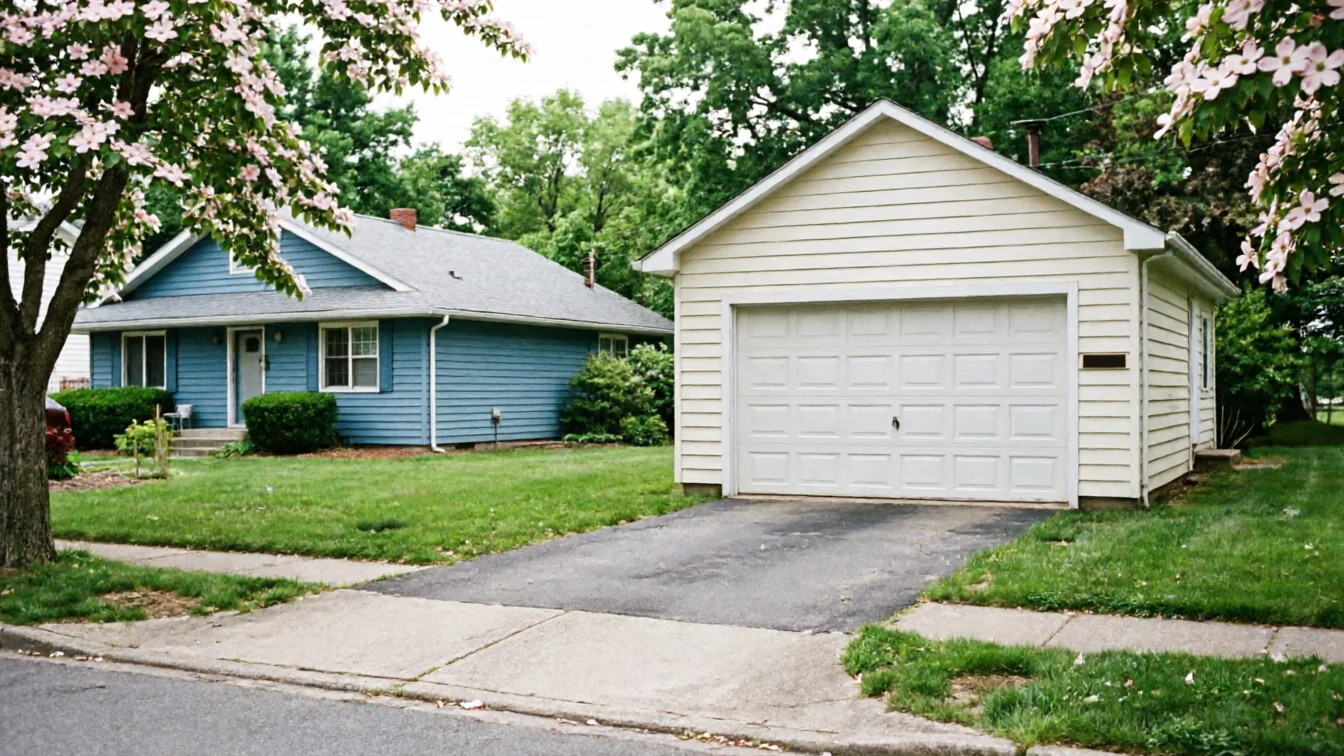
Walk out and look at where your garage sits relative to the house. If it's attached, check the wall that backs onto living space - in this climate band, rated cold and severe, that wall does double duty as insulation, and a door with worn weatherstripping there is losing heat straight into a room someone's paying to warm. If it's detached, check the slab edge and the bottom seal instead, since a detached structure usually isn't heated and the bigger risk is water and ice working into the track rather than heat loss. Either way, grab the door at the bottom corner and lift a few inches by hand with the opener disconnected. It should move with light, even resistance. A door that's heavy on one side usually means a spring or cable issue, not a panel problem. On older detached garages common in Bridgewater's 1960s stock, also check whether the track is side-mounted - a lot of these single-car structures were built with hardware that newer doors aren't designed to bolt onto.
How Local Conditions Play In
Bridgewater sits in a climate band rated cold and severe, and that plays out differently depending on whether the garage shares a wall with the house or stands apart from it. On an attached garage, the door is effectively part of the building envelope - if it doesn't seal tight at the bottom and sides, cold air finds its way into whatever room is on the other side of that wall, and in winter that shows up as a cold floor or a furnace running longer than it should. A detached garage doesn't carry that penalty, but it takes the weather straight on with nothing but the door itself standing between the inside and the season. Across the 100 named areas that make up this part of Somerset County's older housing pattern, most garages from the 1960s and 70s stock were built as single-car detached structures rather than the two-car attached bays common in newer development, so a lot of houses here are dealing with a door style the market doesn't build much of anymore.
What Is Going On
With roughly 186,270 owner-occupied houses across this service area out of about 395,026 households total, the mix of attached and detached garages is wide enough that no single piece of advice covers every house on a given block. If you're closer to Raritan or Somerville than to the center of Bridgewater, your house is somewhat more likely to fall into that older 1938-1966 build window, which often means a detached garage with its own separate electrical run and a door sized for a car narrower than what's on the road today. Houses nearer Martinsville or Branchburg tend to run a bit newer, with attached two-car garages built to match the house's original opening. Neither pattern is a rule, just a tendency tied to when that part of town filled in. What matters for your door is less which category it falls into and more whether the hardware was matched to the structure at the time it was built, or added on afterward.
Frequently asked questions
Does a detached garage door need to be insulated in Bridgewater?
Not for the same reason an attached one does. Since the climate here is rated cold and severe, insulation on an attached door helps keep heat from bleeding into the house wall it backs onto. A detached garage isn't usually heated, so insulation there mainly helps with condensation and temperature swings on stored items, not your heating bill.
Why does my detached garage door feel heavier than the one on my neighbor's attached garage?
A lot of Bridgewater's detached garages date to the 1960s and 70s stock, often built with side-mounted track and heavier wood panels than what's standard now. If the springs haven't been adjusted to match the door's actual weight over the years, it'll feel stiff even when nothing is visibly broken.
Is it worth replacing an old detached garage door or just repairing it?
Depends on the frame underneath, not just the door. If the opening was built square to a 1960s-era single-car width, a repaired door can hold up fine. If the structure has shifted, which happens on older detached garages, a repair might not hold and a full replacement sized to the current opening makes more sense.
Related garage door services in Bridgewater
More garage door guides
Book garage door service in Bridgewater
Call now or request a quote - tell us what the door is doing and where you are.