
Bridgewater, NJ · Garage Door Service
Why Bridgewater's 1960s Doors Need a Different Fix
Bridgewater homes mostly date to the 1960s and 70s, built before insulation rules existed. Here's what that means for your door, your spring, and your winter energy bill.
- Repairs & new doors
- Springs & openers
- Serving 6 nearby communities
What It Costs
We can't quote a number here without a door in front of us, because what drives the bill in Bridgewater isn't the brand, it's the age of the opening. A house with a median build year of 1966 usually has a jamb and header sized for a single-layer steel or wood door, not the thicker insulated panels sold today. Swapping in a modern insulated door often means adjusting the track, the header bracket, or the weatherstrip channel to fit an opening that was framed for something thinner. That's extra labor beyond the door itself, and it's the part homeowners don't expect when they call around for a flat price. Repair costs run lower when the fix is a spring, a cable, or a panel section rather than a full replacement, but on a door old enough to match this area's housing stock, matching parts can take longer to source than a job on a newer build. If your opener and track are original to a 1966-built house, budget time for parts, not just labor. We'll tell you straight if a repair isn't worth it against a full replacement - on doors this old, that's a real conversation, not a sales pitch.
Checking It Yourself
Start at the bottom corner of the door, inside the garage, and press your palm flat against the panel. If it's a single layer of steel with no backing board, you're looking at the kind of door common on houses built in the 1960s and 70s across this area, before any insulation standard applied to garage doors. Next, check the weatherstrip at the bottom edge - on a door this age it's often cracked or missing a section, which lets cold air track straight across the slab. Look at the springs too: torsion springs from an older install sometimes have a thin coat of paint or surface rust that tells you they haven't been replaced since the door went in. If the door is noticeably heavier to lift by hand with the opener disconnected, that's a spring losing tension, not a motor problem. Last, check the track bolts at the header. On older installs these were sometimes mounted directly into wood framing that's shifted slightly over the decades, and a loose bolt there shows up as a grinding sound before anything else fails. None of this needs tools beyond a flashlight and your hands.
How Local Conditions Play In
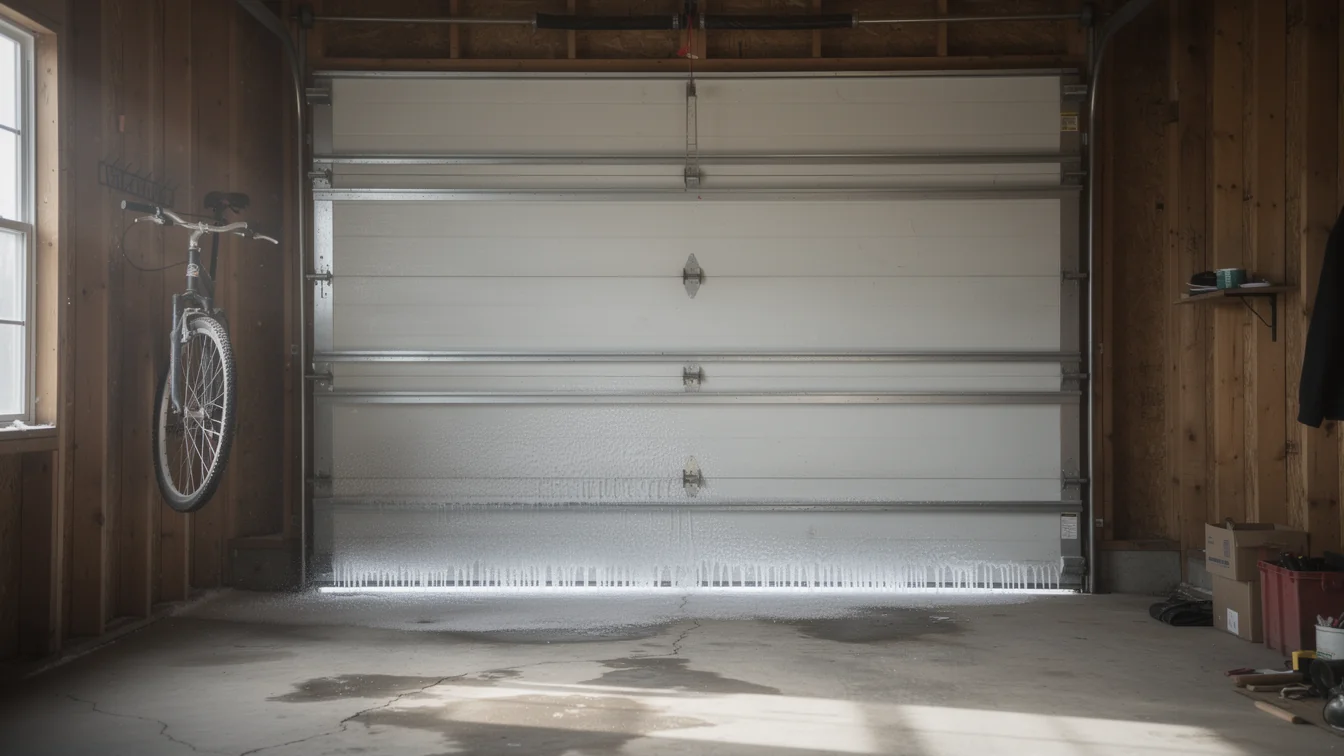
This area sits in a climate band rated cold-severe, and that matters more for an older door than a newer one. Steel contracts in cold weather, and a torsion spring wound to a tension set decades ago shifts slightly tighter as temperatures drop, which is why winter is when a marginal spring finally snaps rather than just squeaks. On a single-layer door with no insulation - standard for houses built around the median year of 1966 - the inside face of the panel can run close to outdoor temperature, so condensation forms on the inside during a freeze-thaw swing and rusts out the bottom panel section from behind, where you can't see it until it's already weak. Nylon rollers also get stiffer in deep cold and put more load on the opener's drive gear during that first lift of the morning. None of this is unique to any one street, but it's consistent across the older housing stock that makes up most of Bridgewater, and it's why a door that's fine in July can fail in January with no warning in between.
What Is Going On
The short version: a lot of garage doors in Bridgewater were installed on houses built before insulation rules existed for this part of a house. Building codes that require insulated garage doors, or treat the garage as thermal envelope, came well after the median 1966 build year for this area's housing stock. So the door you have is doing exactly what it was built to do - keep out rain and close the opening - and nothing more. It was never designed to hold heat, and that's not a defect, it's just the standard of its era. The problem shows up now because openers, springs, and tracks have all been replaced piecemeal over 50-plus years, often by different installers using parts rated for a different door weight or a different spring tension than what's actually hanging in the opening. That mismatch is more common on older stock than new builds, where everything was speced together. If your door feels mismatched - a heavy panel on a light-duty opener, or a spring that was clearly sized for a different door - that history is probably why.
Frequently asked questions
Why does my garage feel so much colder than the rest of the house in winter
If your house dates to the 1960s or 70s, which is typical for this area, the garage door is almost certainly a single layer of steel or wood with no insulation, because that requirement didn't exist when it was built. That uninsulated panel is a direct path for outside cold, especially in a climate band rated cold-severe like this one.
Is it worth insulating an old garage door instead of replacing it
Sometimes. Retrofit insulation kits work on some single-layer steel doors, but on wood doors or doors with damaged panels, the backing doesn't hold well and you're better off replacing. We'll look at the actual panel condition before recommending either.
Why did my spring snap in the middle of winter with no warning
Cold makes steel contract, which tightens the wind on a torsion spring that's already near the end of its life. On older installs common to this area, the spring was often sized decades ago for a lighter door, so the extra cold-weather tension is what finally breaks it.
Related garage door services in Bridgewater
More garage door guides
Book garage door service in Bridgewater
Call now or request a quote - tell us what the door is doing and where you are.