
Bridgewater, NJ · Garage Door Service
Garage Door Cable Repair Serving Bridgewater and the Surrounding Area
Broken or frayed garage door cables on Bridgewater-area homes built from the 1930s to 2001. We explain the failure, the fix, and why cold winters make it worse.
- Repairs & new doors
- Springs & openers
- Serving 6 nearby communities
What You Are Seeing
A cable that's snapped usually shows up one of two ways: the door drops fast on one side and jams crooked in the track, or it won't move at all because the opener senses the imbalance and refuses to run. Sometimes you'll hear it first - a sharp bang from the garage as the cable lets go under tension, followed by the door sagging a few inches on whichever side failed.
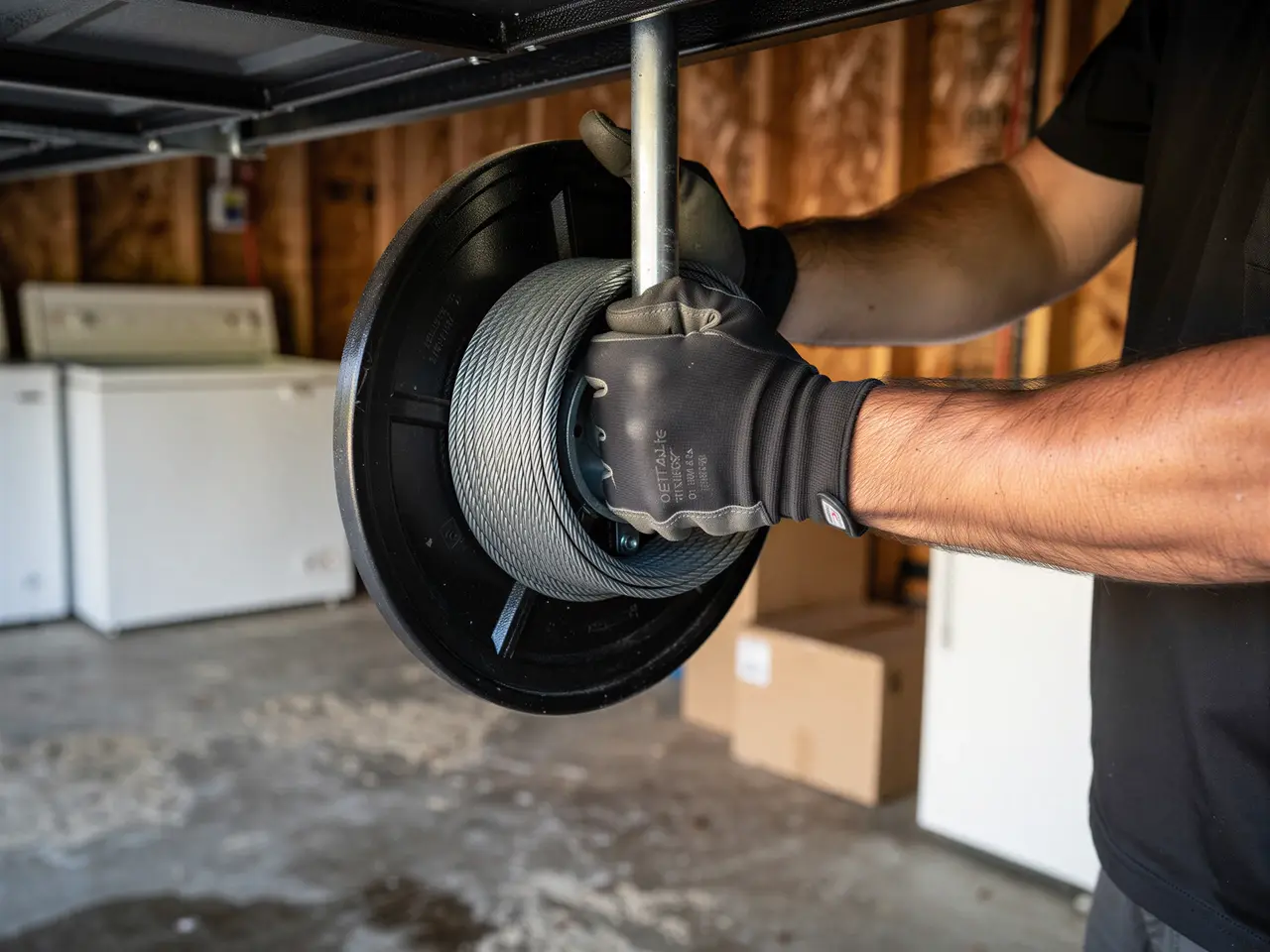
Look at the bottom corners of the door near the tracks. The lift cable runs from the bottom bracket up to the drum at the top of the shaft. If you see frayed strands poking out like a broken bike brake line, or the cable hanging loose and looped instead of taut, that's your answer. On older torsion setups common in homes built before the 1980s, the cable drum and cable are original-spec parts, and once one side goes, the other side is usually close behind.
Don't try to force the door up by hand when a cable's broken. With one side unsupported, the opposite spring and cable are carrying the whole weight unevenly, and the door can jump the track or the remaining cable can whip loose under load. This is a stop-and-call situation, not a tape-and-wait one.
How We Fix It
We replace the cable in pairs, not one at a time. If one lift cable has frayed or snapped from fatigue, the other has seen the same cycles and the same stress, and it's close to the same age - sending us back out in a month for the second one costs you more than doing both now. We release spring tension first, pull the old cables and drums, check the bottom brackets for wear since a worn bracket chews through a new cable fast, and set the new cable to proper tension on both sides before we test the balance.
On homes with original hardware from the 1960s and 70s stock common across this area, drum sizing and cable gauge aren't always a match for what's sold off the shelf today, so we measure rather than assume. We also check the track alignment while we're in there - a cable snapping under even load usually means the track was fine, but a cable snapping unevenly, bottom bracket torn loose, or track visibly bent on one side points to a different root cause we'll flag before we touch anything else.
One limitation worth saying plainly: if the drum or shaft is worn from running on a frayed cable for weeks, cable replacement alone won't fix the noise or the rough travel. That's a shaft and bearing job, and we'll tell you straight if that's where you've landed instead of letting a cheaper fix fail again in a month.
Where This Job Goes Sideways
The most common mistake we see is someone replacing just the broken cable and leaving the matching one, original to the same install. It holds for a while, then lets go on its own schedule, usually on a morning when you're already late. We quote the pair up front so there's no surprise return trip.
The second way this goes wrong is skipping the spring check. A cable under extra load from a weakening torsion spring will fray faster than a cable on a properly tensioned system. Replace the cable without addressing a tired spring and you're back here in under a year.
Third: mismatched cable gauge. Homes in this area span construction from the late 1930s through the early 2000s, and hardware specs drifted a lot over those six decades. A cable that's close enough in diameter will seem to work, then slip on the drum or wear unevenly within months. We match gauge to the drum, not to whatever's cheapest on the truck that day.
Last, and least obvious: ice and condensation inside an unheated garage can freeze a cable to the track or drum overnight. Forcing the opener against a frozen cable is how a fine strand becomes a snapped one, and it happens more in a severe-cold winter than people expect from a two-car garage.
Why It Happens Here
This area's housing stock runs from 1938 through 2001, with the median build year around 1966, and most of the hardware we find in garages still matches that era - steel cables, steel drums, torsion springs sized for doors that were lighter than what's sold today. Cable wears by cycle count and by temperature swing, and a 55-to-60-year-old cable on original drums has seen a lot of both.
The region sits in a cold-severe climate band, and that matters more for cable than people assume. Steel cable stretches and contracts with temperature, and the zinc coating that protects the strands from rust is thinner after decades of freeze-thaw cycling in an unheated or marginally insulated garage. Add road salt tracked in on tires and boots over a winter, and you get corrosion starting from the inside of the cable wrap, invisible until a strand gives.
Across the roughly 186,270 owner-occupied houses in this service area, a meaningful share are still running the hardware they were built with. That's not a knock on the houses - it's just cable doing sixty years of work it was never going to do forever. We see the same failure pattern on 1960s and 70s builds across the towns we serve, and it tracks with age and winter exposure more than with anything else.
Frequently asked questions
Can I drive on a broken garage door cable for a day or two?
No. With one cable gone, the door's weight is unevenly supported by the remaining cable and spring, which can snap next or let the door jump the track. Leave the door closed and don't run the opener until it's fixed - one more cycle can turn a one-side repair into a full hardware replacement.
Why do you replace both cables instead of just the broken one?
Both cables go through the same cycles at the same age, so if one has frayed from fatigue, the other is close behind. Replacing just one means you're likely calling again within months for the second side. We replace the pair in one visit to avoid a second trip and a second bill.
Is a snapped cable always a sign of a bigger problem?
Not always, but it can be. If the break came with a bent track, a torn bottom bracket, or a spring that looks stretched or uneven, that's a separate issue feeding the cable failure. We check all of it during the cable job and tell you plainly if there's more going on.
Does cold weather really affect garage door cables?
Yes. Steel cable contracts in cold and the protective coating thins with decades of freeze-thaw exposure, especially with road salt tracked into an unheated garage. In a severe-cold climate like this one, older cables corrode from the inside before any fraying is visible from outside.
Related services
Related guides
By Neighborhood
Cable Repair across the Bridgewater area
We also handle cable repair in these Bridgewater-area suburbs.
Book garage door service in Bridgewater
Call now or request a quote - tell us what the door is doing and where you are.