
Bridgewater, NJ · Garage Door Service
Garage Door Spring Repair in Bridgewater and the Surrounding Area
Broken torsion or extension springs on Bridgewater's 1960s-70s housing stock, explained and fixed by a crew that knows the cold-climate wear pattern here.
- Repairs & new doors
- Springs & openers
- Serving 6 nearby communities
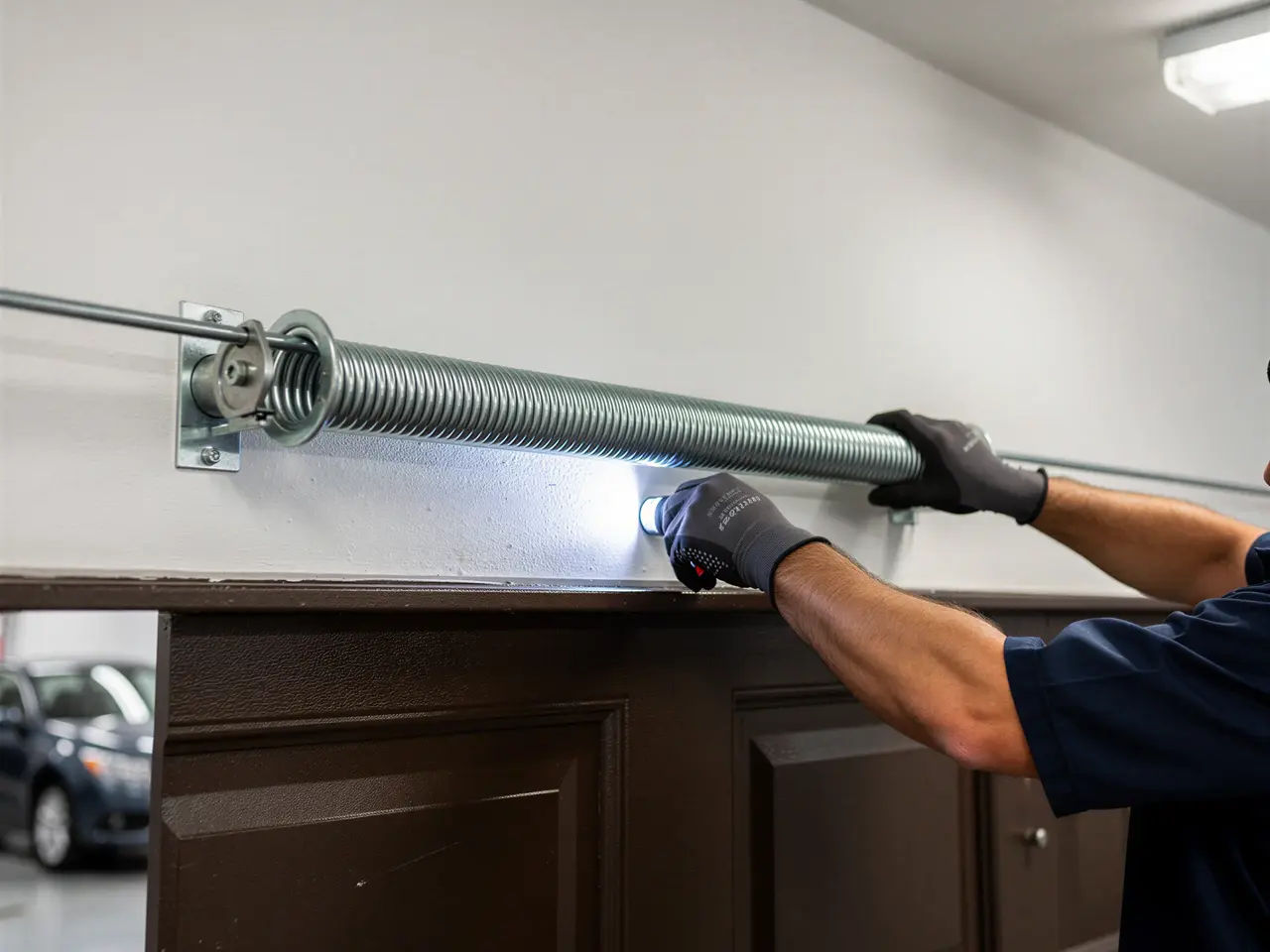
What You Are Seeing
The door won't move, or it moves and then slams the last foot of travel. Sometimes there's a loud bang from the garage first, usually when nobody's home, and when you go check, one of the springs above the door is pulled apart with a visible gap. On older setups you'll see two stretched extension springs along the horizontal tracks; on newer ones it's usually a single torsion spring mounted on a bar above the opening, wound tight until it isn't.
Most houses in this area were built between 1938 and 2001, with a lot of that stock going up in the 1960s and 1970s across the towns we cover. That means plenty of original torsion hardware that's never been touched, and springs that were rated for a lighter steel door than whatever's hanging there now if the door's been replaced once already. If your opener strains, reverses halfway up, or the door feels heavy when you lift it by hand with the opener disconnected, that's a spring losing tension before it fully fails.
How We Fix It
We don't patch a spring. A stretched or broken torsion spring gets replaced in a matched pair, even if only one side let go, because the other one is close behind on cycle count and a mismatched pair just throws the door off balance again in a few months. We measure wire diameter, coil length, and inside diameter against the door weight and track type before we order, since the wrong spring binds the opener or wears the cables fast.
Part of the job is checking what the spring was compensating for. A worn bottom roller, a bent track, or cables fraying at the drum will burn out a new spring just as fast as the old one. So the repair includes a check of the drums, cables, and center bearing plate, not just the spring itself. If the opener's travel limits or force settings are off because the door's been fighting a bad spring for months, we reset those too so the opener isn't doing the spring's job going forward.
Where This Job Goes Sideways
The honest limitation first: if the torsion bar is bent, the bearing plate has cracked, or the door panels are racked from being forced while the spring was out of balance, spring replacement alone doesn't fix it. That's a structural repair or a door replacement conversation, not a spring swap, and we'll tell you straight if that's what we're looking at rather than sell a spring job that won't hold.
The other place this goes wrong is DIY. Torsion springs are wound under real tension, and backing out the set screws on a winding cone without the right bars is how people lose fingers or get hit by the bar. We've also seen owners install a spring rated for the wrong door weight because a hardware store clerk guessed off the opening size instead of the actual door. That undersized spring fails again in weeks, sometimes taking the opener's drive gear with it.
Why It Happens Here
This area sits in a cold, severe climate band, and that matters for spring steel. Overnight temperature swings in winter make the metal more brittle right at the moment the door's being cycled the most, since everyone's running the garage door more in short cold spells than they would in a mild fall week. A spring that's already near the end of its cycle life is more likely to snap on a 15-degree morning than a 55-degree one.
Combine that with the age of the housing stock across the service area, mostly 1960s and 70s construction, and you get a lot of original or first-replacement springs that have outlived their rated cycle count without anyone tracking it, because nobody keeps a log on a garage door spring. Across the roughly 186,270 owner-occupied houses in this region, a large share were built before torsion spring technology was even standard, so the hardware mix varies house to house more than people expect.
Frequently asked questions
How long does a spring replacement take?
Most single-spring or paired-spring jobs are done in under two hours once we're on site with the right part, assuming the tracks and cables are in good shape. If we find a bent track or damaged bottom bracket underneath, that adds time.
Can I just replace one spring if only one broke?
You can, but we don't recommend it. Both springs wear on the same cycle schedule, so if one let go, the other is usually close behind. Replacing them as a pair keeps the door balanced and saves you a second call in a few months.
Why did my spring break in cold weather specifically?
Spring steel gets more brittle as temperatures drop, and this area sits in a cold, severe climate band with real winter swings. A spring near the end of its life is more likely to snap on a cold morning when the metal is stiffer and the door's being cycled a lot.
Is it safe to open the garage door by hand after a spring breaks?
You can release the opener and lift manually, but the door will be heavy and may not stay up without the spring's counterbalance. Treat it as a temporary measure only and don't let kids or anyone else operate it until the spring's replaced.
By Neighborhood
Spring Repair across the Bridgewater area
We also handle spring repair in these Bridgewater-area suburbs.
Book garage door service in Bridgewater
Call now or request a quote - tell us what the door is doing and where you are.