
Bridgewater, NJ · Garage Door Service
What Wind Does to a Wide Double Door Around Bridgewater
Bridgewater's older double-wide garage doors weren't built for today's wind loads. Here's what to check, what drives repair cost, and why this housing stock is exposed.
- Repairs & new doors
- Springs & openers
- Serving 6 nearby communities
What It Costs
There's no flat number I can give you here, because what a wind-damaged wide door costs depends on what's actually bent versus what's just scared you. A single dented panel on a 16-foot door is a different job than a track pulled off the wall or a center stile that's folded.
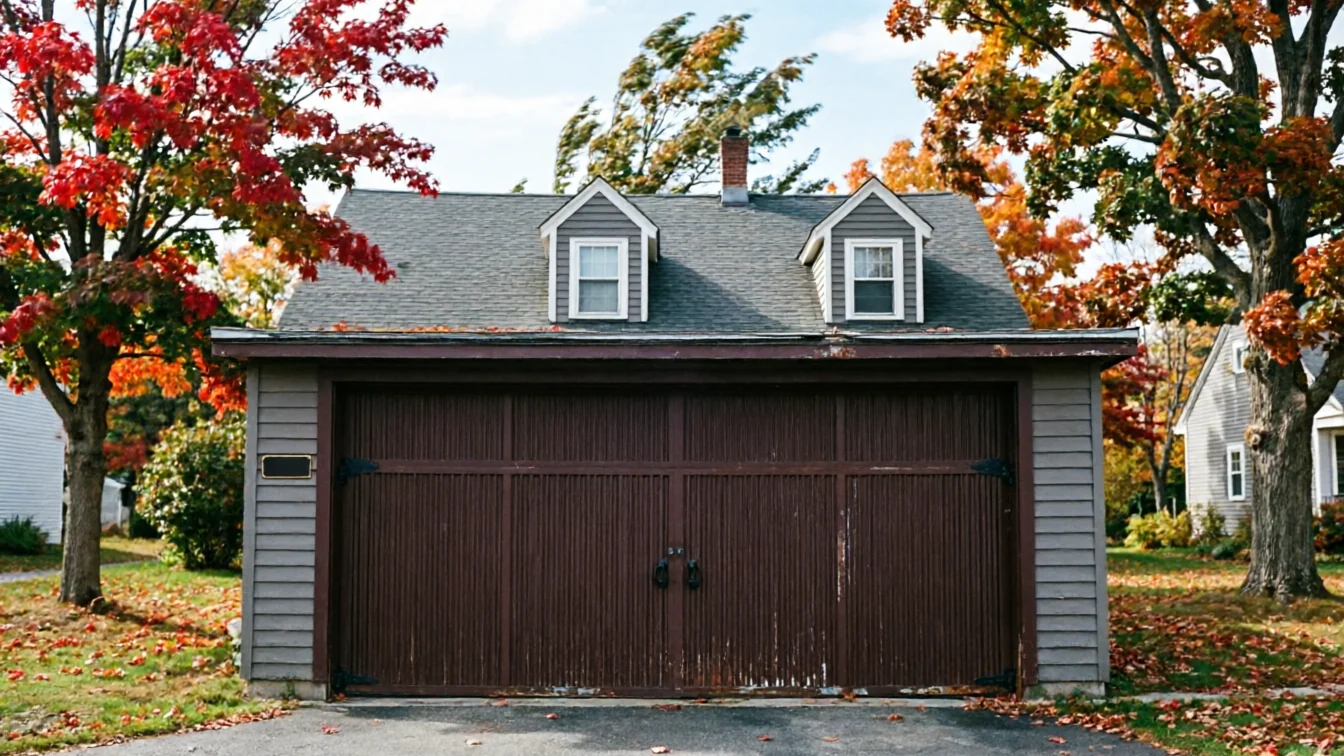
What does change the number: whether the door is a true two-car wide (common on the tract housing built here through the 1960s and 70s) or two single bays side by side, whether the torsion bar bent along with the track, and whether the opener's drive gear took a hit when the door racked sideways. Wide doors carry more surface area per panel than a single door, so when wind gets under the bottom seal and lifts, the load spreads across more unsupported span before it reaches a support point. That's structural, not cosmetic, and it changes what needs replacing versus straightening.
One honest limit: if the door is original to a house built in that 1938-2001 window, with a median around 1966, we often can't match the panel. Those profiles aren't made anymore. At that point you're pricing a full door, not a patch, and that's a conversation we have in person, not a number I'll put on a page.
Checking It Yourself
Before you call anyone, walk the door from the outside on a calm day. Stand back and sight down the face panel by panel - a wide door that's taken a wind hit usually shows a faint wave or bow across one or two panels before it shows anywhere else.
Check the horizontal struts on the inside, the reinforcing bars bolted across the back of the top one or two panels. On a lot of the doors still in service from the 1960s-70s building wave, those struts are thinner than what gets installed today, or missing from the bottom panels entirely. If a strut has popped loose from its end bracket, you'll see a gap where it used to sit flush.
Run the door by hand with the opener disconnected. If it binds, scrapes, or needs a shove partway up, the track has likely shifted, which is common after a door gets pushed from the outside. Look at the vertical track seams near the top rollers - that's where a sideways load concentrates first on a wide door, because the span between rollers is longer than on a single-car door.
If any of this is present, stop running the opener on it. A bowed panel under motor force can crack further or pull the opener's drive arm loose.
How Local Conditions Play In
This area sits in a cold, severe climate band, and that matters for wide doors specifically because of how wind and snow load interact with a long, unsupported span. A gust that would just rattle a single-car door can flex a 16-foot door enough to pop a center lock or bow a thin panel, especially once wet snow has added weight to the top section.
Most of the housing stock here was built between 1938 and 2001, with the median landing around 1966, across roughly a hundred named areas in this part of the county. Doors from that era, and a lot of the doors installed as replacements through the 70s and 80s, were built to specs that didn't account for the wind-pressure ratings used today. They're lighter gauge, with fewer or thinner struts, on track hardware sized for a calmer load than what a severe winter actually delivers.
The practical result: a wide garage door on a house from that building wave is carrying a bigger surface area on hardware that was never rated for the wind loads this climate band produces in a bad storm. That's not a flaw unique to any one house - it's a mismatch between the era of the door and the weather it's now expected to hold against.
What Is Going On
A garage door fails under wind the same way a sail fails - not by snapping cleanly, but by flexing until something at the weak point gives. On a wide door, the weak point is almost always the center, the furthest spot from both side tracks and the point where two panel halves meet if it's a double door.
Wind doesn't push evenly. A gust that gets under the bottom seal creates uplift pressure on the whole face, and a wide door has more square footage for that pressure to act on than a single door does, with the same number of attachment points along each side. The center sags or bows first, which is why you'll see the wave in the middle panels before you see it at the edges.
Once a panel has bowed, even slightly, it stops sitting flush in the track, and every open-close cycle after that grinds a little more wear into the rollers and the track wall. That's the part people miss - the storm damage and the ongoing wear from running a bowed door are two separate problems, and the second one keeps compounding after the wind is gone.
This is true for doors from any era, but it shows up fastest on the lighter-gauge double-wide doors common in houses built here through the 1960s and 70s, where the original hardware was sized for a calmer load than this area's winters now deliver.
Frequently asked questions
My double-wide door bowed in the last windstorm but still closes. Do I need to deal with it now?
Yes, sooner than later. A bowed panel doesn't sit flush in the track anymore, so every cycle grinds extra wear into the rollers and track wall. It also won't take the same wind load twice - the next gust works on an already-weakened panel. Get it looked at before you run it through many more open-close cycles.
Why does my neighbor's single-car door seem fine but my double is bowed?
Surface area. A double-wide door has more unsupported span across the center than a single-car door, so the same wind pressure concentrates more force in the middle panels. Houses in this area built through the 1960s and 70s often have double doors on hardware sized for lighter loads than this climate's winters actually produce.
Can I just add a strut myself instead of calling someone?
If the track and rollers are undamaged and the panel isn't cracked, a strut retrofit is a reasonable fix. But if the panel is already bowed or the track has shifted, bolting a strut to a compromised panel doesn't fix the underlying flex - it just redistributes it. Worth having someone check the track alignment first.
Related garage door services in Bridgewater
More garage door guides
Book garage door service in Bridgewater
Call now or request a quote - tell us what the door is doing and where you are.