
Bridgewater, NJ · Garage Door Service
Why a Garage Door Goes Off Track Here in Bridgewater
A look at why garage doors jump track in Bridgewater, tied to the town's 1938-2001 housing stock, its mostly 1960s-70s hardware, and the area's severe cold winters.
- Repairs & new doors
- Springs & openers
- Serving 6 nearby communities
What It Costs
We can't give you a flat number here, and anyone who does without seeing the track is guessing. A door that's hopped the track because one roller popped out of a bent section is a different job than one where the whole horizontal run has pulled loose from the framing - and in Bridgewater, where most garages were built between 1938 and 2001 with a lot of that stock dating to the 1960s and 70s, we see both. Older track brackets lag-bolted into sixty-year-old framing sometimes need the wood behind them sistered or replaced before a new bracket will hold, and that adds labor you won't find in a generic repair estimate. What we can tell you is that a straightforward re-hang of a track that's shifted but not bent costs a lot less than one where a roller has chewed up the track rail itself, and that the gap between those two jobs is usually visible before we even open the door panel. Given the median household income across this service area runs north of $130,000, we find most owners here would rather pay for the fix that actually lasts than the cheapest patch - worth knowing before you start calling around for the lowest quote.
Checking It Yourself
Open the door partway and look at the horizontal track section where it meets the vertical rail on either side. In homes built through the 1960s and 70s - which covers a large share of garages in this part of the county - that joint is often a bolted splice plate, and on original hardware it's had decades to work loose. A gap of more than an eighth of an inch between the roller and the track at that joint is your sign. Next, run your hand along the track for a spot where it's pulled away from the wall bracket; on houses from the 1938-2001 build window, those brackets are frequently fastened straight into jamb framing that has settled over the years, not into the masonry some newer installs use. If the door binds at one specific point every time rather than dragging the whole way, that's usually a single bent section, not a track-wide problem. We won't tell you to pull the door off track yourself to check it - with the spring still under tension that's not a DIY step, and it's where a lot of avoidable injuries happen.
How Local Conditions Play In
This area sits in a climate band the federal data marks as severe cold, and that matters more for garage doors than people expect. Every winter the freeze-thaw cycle moves the concrete slab under the garage floor a small amount - not enough to crack it, usually, but enough to change the level where the vertical track meets the floor. On a door that was set true when the house went up decades ago, that slow seasonal movement adds up, and it's one of the more common reasons we find a track that's technically still attached at every bracket but no longer running straight. Houses closer to the older parts of town, built in the earlier end of the 1938-2001 range, tend to show this more because the slab has had more winters to move. It's also why a track that looked fine in August can start binding in January - the wood framing contracts in the cold at a different rate than the steel track bolted to it, and that's enough to pull a bracket a hair out of line.
What Is Going On
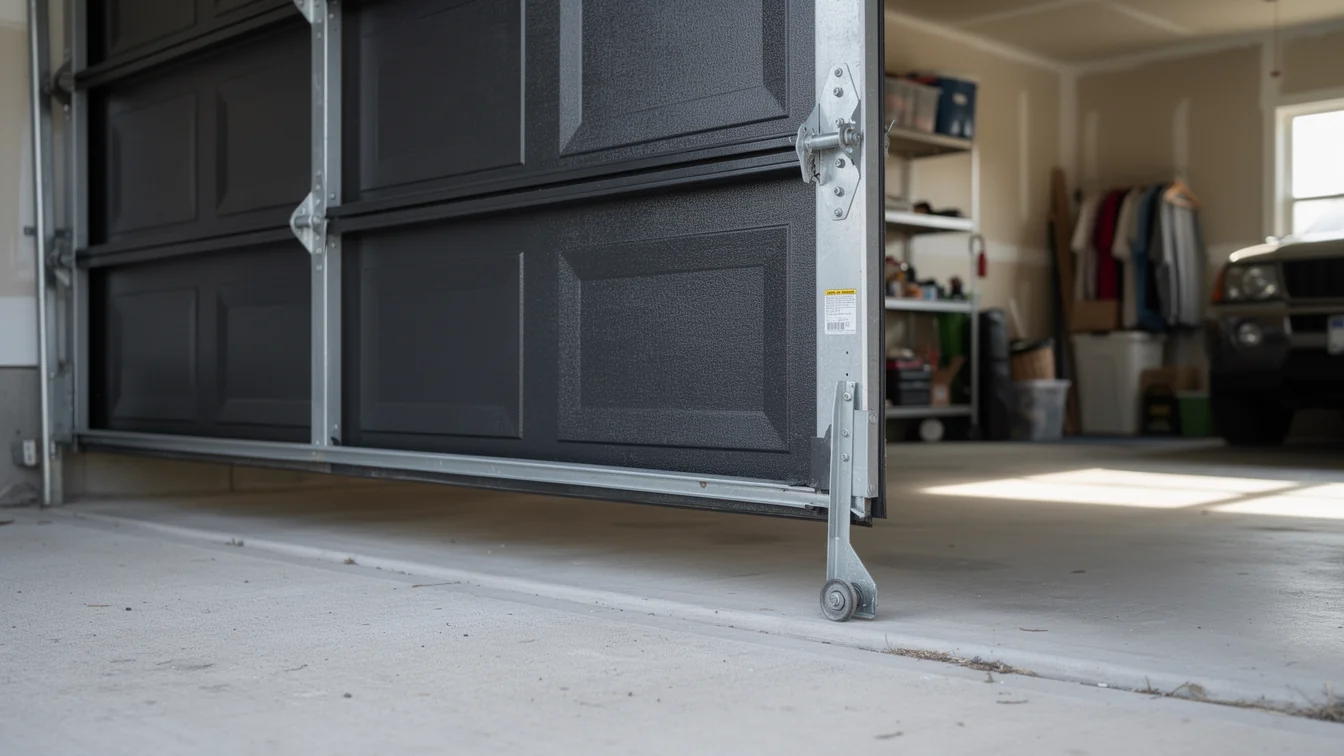
A door goes off track almost always for one of three reasons: a roller has broken or worn down enough to slip free of the rail, a track bracket has loosened from the framing behind it, or the track itself has been bent - usually from a car bumping it or from a cable that's come off a drum and let the door drop unevenly on one side. In Bridgewater's older housing stock, bracket loosening shows up more than the other two combined, simply because so much of the hardware dates back decades and was fastened into wood that's shifted with age. A door that's off track on one side only, while the other side still rolls smooth, almost always points to that side's cable or bottom bracket rather than the track itself. We'll say plainly that once a track is bent rather than just loose, straightening it rarely holds - replacing that section is the honest fix, even though it costs more up front than trying to hammer it back into shape.
Frequently asked questions
Can I just push the door back onto the track myself?
No. With the spring under tension, forcing a door back onto a bent or loose track can snap a cable or let the door drop suddenly. If it's off track on one roller only and the door is down, you can sometimes free the roller by hand, but anything involving the spring or a door that's partway open needs a call.
Why did my door start binding only in winter?
Cold contracts the wood framing your track is bolted into faster than it contracts the steel track itself, and freeze-thaw movement in the slab shifts the floor-level alignment too. On older Bridgewater-area hardware from the 1960s and 70s, that seasonal shift is often enough to turn a slightly loose bracket into a binding door.
Is it the track or the rollers that usually fail first?
In the housing stock common here, dating from 1938 through the early 2000s, we see bracket and fastener failure more often than the track or rollers themselves giving out. The track is usually fine; what's failed is what's holding it to the framing.
Should I replace the whole track or just the bad section?
If only one section is bent or the bracket's pulled loose, we replace that section and check the rest for the same wear. A full track swap only makes sense if multiple sections are bent or the whole run has aged out - we won't sell you a full replacement if a section repair will hold.
Related garage door services in Bridgewater
More garage door guides
Book garage door service in Bridgewater
Call now or request a quote - tell us what the door is doing and where you are.